Bucketlist
Researching why group-chat plans fall through
Friends float plans in group chats all the time: a trip, a concert, a restaurant someone saw on Instagram. Most of them never happen. Before designing anything, our team set out to understand why. This is the research behind Bucketlist, an iMessage plug-in that helps plans make it out of the group chat.
Role
Product Designer
Team
5 Product Designers
Timeline
6 weeks, 2025
Methods
Interviews, journey mapping, usability testing

TL;DR
We wanted to know why plans made in group chats so rarely happen. We compared 6 planning tools, interviewed 10 young adults, and mapped how their plans unfold from the first idea to follow-through.
Plans weren’t failing for lack of interest. They got buried in the chat, stayed vague on dates, and depended on one person to push them forward.
Those insights shaped an iMessage plug-in. Usability testing with 9 users showed us where the concept was unclear, and the final design raised navigation success by 58% over the mid‑fi prototype.
6
tools compared
10
interviews
9
usability test participants
The problem
Plans start in the group chat, and most of them end there
Group chats have become the default place to make plans. Ideas for trips, restaurants, and events come up naturally in conversation, but turning them into something real takes follow-up, coordination, and someone willing to push. Without that, the idea scrolls away and is forgotten.
What we set out to learn
01
How do friends actually make plans together today?
02
Where in the process do plans stall or quietly die?
03
Why don’t existing tools close that gap?
Competitive analysis
Planning tools either live outside the chat or stop once the plan is made
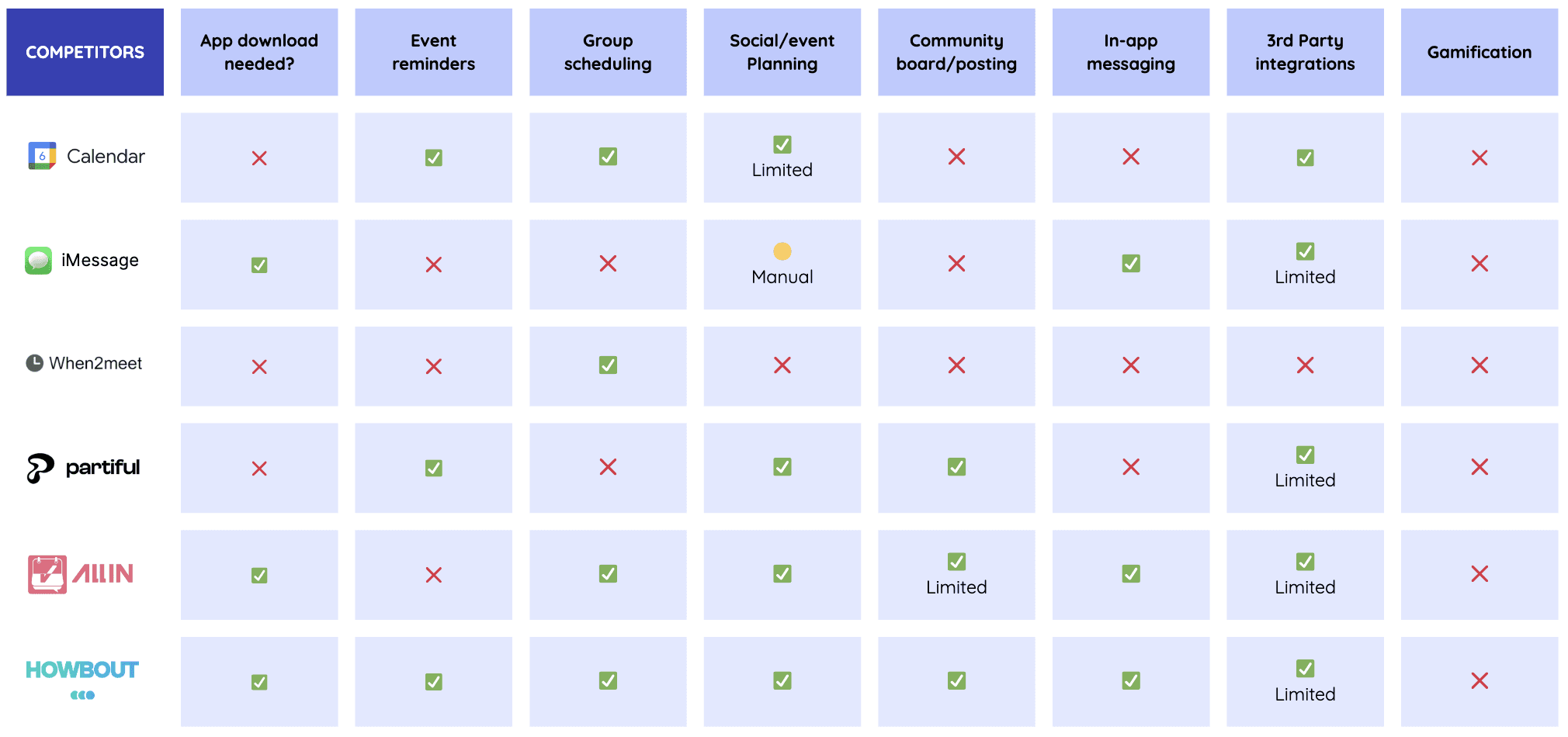
We compared 6 tools people already use to make plans, from Calendar and iMessage to When2meet, Partiful, ALLIN, and Howbout, across 8 features. I worked with the team to define the evaluation criteria.
01
The chat has no structure
iMessage is where plans start, but it has no reminders or group scheduling. Every step is manual.
02
Structure means switching apps
Partiful, ALLIN, and Howbout organize events well, but they pull the group out of the chat and into a new app or sign-up.
03
Follow-through is left out
None of the six used motivation or rewards to keep people engaged once a plan was made.
User interviews
We talked to 10 young adults about how their plans really happen
Participants were 22 to 28, including 3 who self-identified as having ADHD. I co-developed the interview guide and conducted 2 of the 10 interviews.
Planning behaviors
How plans start, where ideas come from, and who makes the first move.
Collaboration habits
How friends agree on a time, share details, and split the work.
Breakdown points
The moments a plan stalls, gets forgotten, or quietly falls apart.
“
Figuring out availability is a nightmare. I’m okay with planning, but if no one responds it makes me really stressed out.
— busy grad student, 24
“
If I didn’t initiate, things wouldn’t happen.
— overworking software engineer, 26
Synthesis
Mapping the journey showed where plans lose momentum
We sorted what we heard into an empathy map and an affinity map, and defined two personas: the Planner and the Follower. I hand-illustrated the user journey map so the team could see the whole planning process, from the first idea to follow-through, in one view.

Empathy map
What participants said, thought, did, and felt about planning with friends.

Discovery
Excited
Ideas spark on social media and land in the chat.
Coordination
The low point
Replies are slow, so one person chases everyone to find a time.
Planning
Scattered
Links get buried, and not everyone gives input.
Follow-through
Uneasy
No one’s sure who’s still in, and plans change last minute.
Key insights
Plans don’t fall through for lack of interest. They stall in three predictable ways.
01
Plans disappear when they lose visibility
Ideas, links, and dates get buried as the chat moves on. Without a place to hold them and reminders to bring them back, people forget to follow up.
02
Friends talk about “sometime,” not exact dates
People prefer casual, spontaneous hangouts over rigid scheduling. Pinning down a date too early drains the excitement, but leaving it open means the plan never lands.
03
No one wants to be the planner every time
Organizing usually falls on one person, and over time it starts to feel like work. People wanted planning to feel simple and shared, not stressful.
From insights to ideas
We reframed the insights as “How might we” questions to anchor our brainstorm in what people actually needed.
How might we…
01
Make it easier to turn ideas and goals into plans?
02
Help friends easily find a time that works for everyone?
03
Make it easier for everyone to give input on plans?
04
Help people remember plans and stay updated without too many messages?

Brainstorming around the questions
Ideas ranged from auto-polls and a browser plug-in to a wearable. An iMessage integration stood out because it meets people where plans already start.
Usability testing
We tested the concept with 9 users before going high-fidelity
We built a mid-fidelity paper prototype and ran live, moderated sessions with 9 participants. Each person walked through the core journey: capture an idea, turn it into a plan, and stay on top of it.


What worked
Planning right inside iMessage
Seeing everyone’s availability in one place
Having reminders and responsibilities built in
What confused people
Where Bucketlist lived and how to open it
What the banner at the top was for
How to read and answer the poll
What changed in the final design
We made the entry point obvious and rebuilt polls with familiar iOS patterns. Tested against the mid-fi prototype, the final design was easier to navigate and made progress clearer.
↑ 58%*
navigation success
↑ 44%*
progress clarity
7 / 9
users found it helpful
* Final design compared with the mid-fi prototype in usability testing.
What I learned
The gaps in a market say as much as the features
Our competitive analysis was most useful for what no tool offered: none of the six helped groups follow through once a plan was made. That empty column became the starting point for the roles and rewards in our design.
Drawing the journey made the problem visible
Hand-illustrating the journey map forced me to decide what mattered at each stage. It gave the team one shared picture of where plans lose momentum, and it is where our core insights came from.
