User Research · App Design · User Testing
BucketList
helping plans “make it out of the group chat”
Company / Client
School Project (UW MHCID)
Duration
6 weeks
Date / Year
Nov 2025 – Dec 2025
Team
5 HCI Master Students
My Role / My Contribution
UX Researcher, UX Designer
Skills
User Research, App Design, User Testing, Prototyping
Deliverables / Final Output
A prototype of a Plugin in iMessage
In a Nutshell
Bucketlist is a playful yet functional iMessage integration that helps groups capture ideas as they emerge in conversation, organize shared bucket-list goals, assign to-dos, and turn plans into action.
What's the Problem?
Group chats have become the default place for making plans. Ideas for trips, restaurants, events, and future adventures are often sparked organically in conversation.
Yet most of these plans never materialize. Coordinating multiple people requires effort, follow-up, and ongoing engagement, causing many exciting ideas to get buried in chat history and forgotten. While people frequently talk about things they want to do together, but rarely have a lightweight way to keep track of those ideas and carry them forward.
This creates a gap between conversation and commitment: plans are discussed, but rarely tracked, prioritized, or acted upon.
Task
Design a lightweight planning experience that helps groups move from discussing future ideas to actually following through on them within their existing conversations.
The solution needed to:
Capture and organize ideas before they get lost in chat history.
Maintain a shared space for group bucket-list items.
Increase the likelihood that informal plans turn into real-world actions.
Reduce coordination overhead and friction in group decision-making.
Help users stay on track with plans and follow-through, especially those who struggle with attention, task management, or consistency.
Avoid requiring users to adopt a separate app or workflow outside iMessage.
The goal was to bridge the gap between intention and execution in group chat–driven planning.
Process
User Research
We needed to ground our direction in evidence before committing to a concept—both by understanding where existing solutions fell short, and by building a clear picture of the people we were designing for.
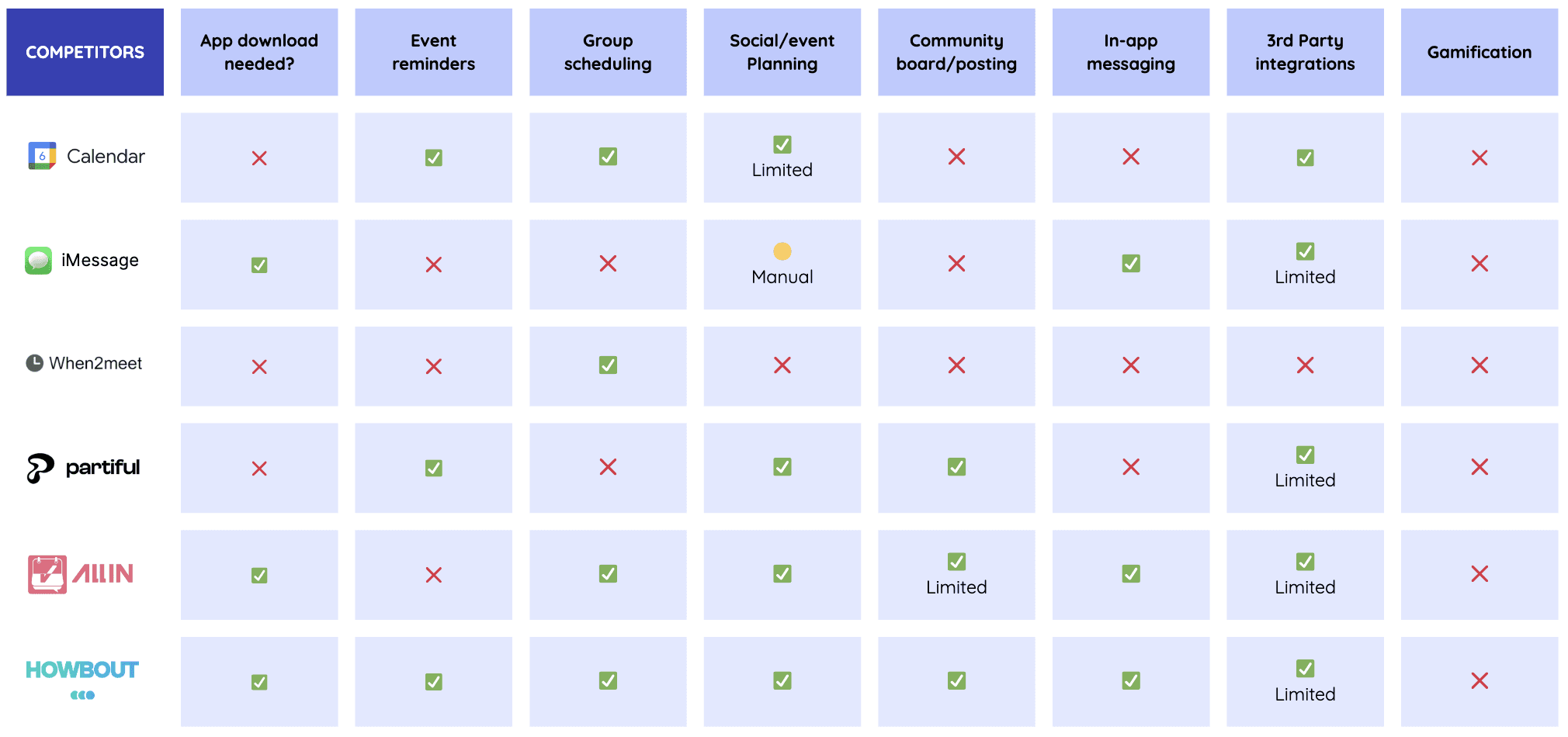
Competitive Analysis
I collaborated on defining the evaluation criteria and metrics used to assess 6 competitors, which surfaced clear market gaps and opportunity areas.
Interview
I then co-developed the interview guide and conducted 2 of 10 user interviews (participants aged 22–28, including individuals who self-identified as having ADHD), focusing on real planning behaviors, collaboration habits, and breakdown points in follow-through.
Empathy Map & Affinity Map
To make the research actionable, I contributed to synthesizing findings into an empathy map, affinity map.

User Journey Map
I also hand-illustrated the user journey map to help the team visualize key friction points across the planning process, which led to five core insights.

The 5 Key Insights from User Research:
Plans often get lost in group chats and conversations, and people forget to follow up.
Friends prefer casual, spontaneous hangouts over rigid scheduling.
No one wants to be the planner all the time, since organizing feels like extra work.
Reminders and updates make it easier to remember and show up
People want planning to feel simple and shared, not stressful.
Design Implication:
People want a centralized, social space for planning that keeps the ease of group chats but adds organization, shared reminders, and low-effort coordination.
Ideation
With research insights established, we needed to expand the solution space before converging on a direction, while avoiding premature narrowing of ideas.
Brainstorm
We structured ideation around “How Might We” questions to anchor brainstorming in validated user needs.
How Might We:
Make it easier for people to turn ideas and goals into plans?
Help friends easily find a time that works for everyone?
Make it easier for everyone to provide their input on plans?
Help people remember upcoming plans and stay updated without too many messages?

Interview
I then co-developed the interview guide and conducted 2 of 10 user interviews (participants aged 22–28, including individuals who self-identified as having ADHD), focusing on real planning behaviors, collaboration habits, and breakdown points in follow-through.
Empathy Map & Affinity Map
To make the research actionable, I contributed to synthesizing findings into an empathy map, affinity map.
User Journey Map
I also hand-illustrated the user journey map to help the team visualize key friction points across the planning process, which led to five core insights.
The 5 Key Insights from User Research:
Plans often get lost in group chats and conversations, and people forget to follow up.
Friends prefer casual, spontaneous hangouts over rigid scheduling.
No one wants to be the planner all the time, since organizing feels like extra work.
Reminders and updates make it easier to remember and show up
People want planning to feel simple and shared, not stressful.
Design Implication:
People want a centralized, social space for planning that keeps the ease of group chats but adds organization, shared reminders, and low-effort coordination.
Result
Share the outcome. What shipped, what changed for users and for the business, and what you learned. Use the before & after below to make the impact tangible.